


All categories >
Starting at $3,000 per container! A sky-high fine from ONE is sounding an alarm—compliance declarations for ocean shipping must be handled this way!
Categories:
Time of issue:
2025-12-05 17:13
With just one penalty notice, the cost of misreporting soars.
In mid-November, the ONE vessel "ONE Henry Hudson" suddenly caught fire at the Port of Los Angeles, prompting the shipping company to declare a general average. On December 1, ONE swiftly followed up with new regulations: effective January 1, 2026, misdeclaration of cargo will incur a minimum fine of US$3,000 per container, while mandatory corrections for dangerous goods will carry an even higher penalty of up to US$30,000 per container.
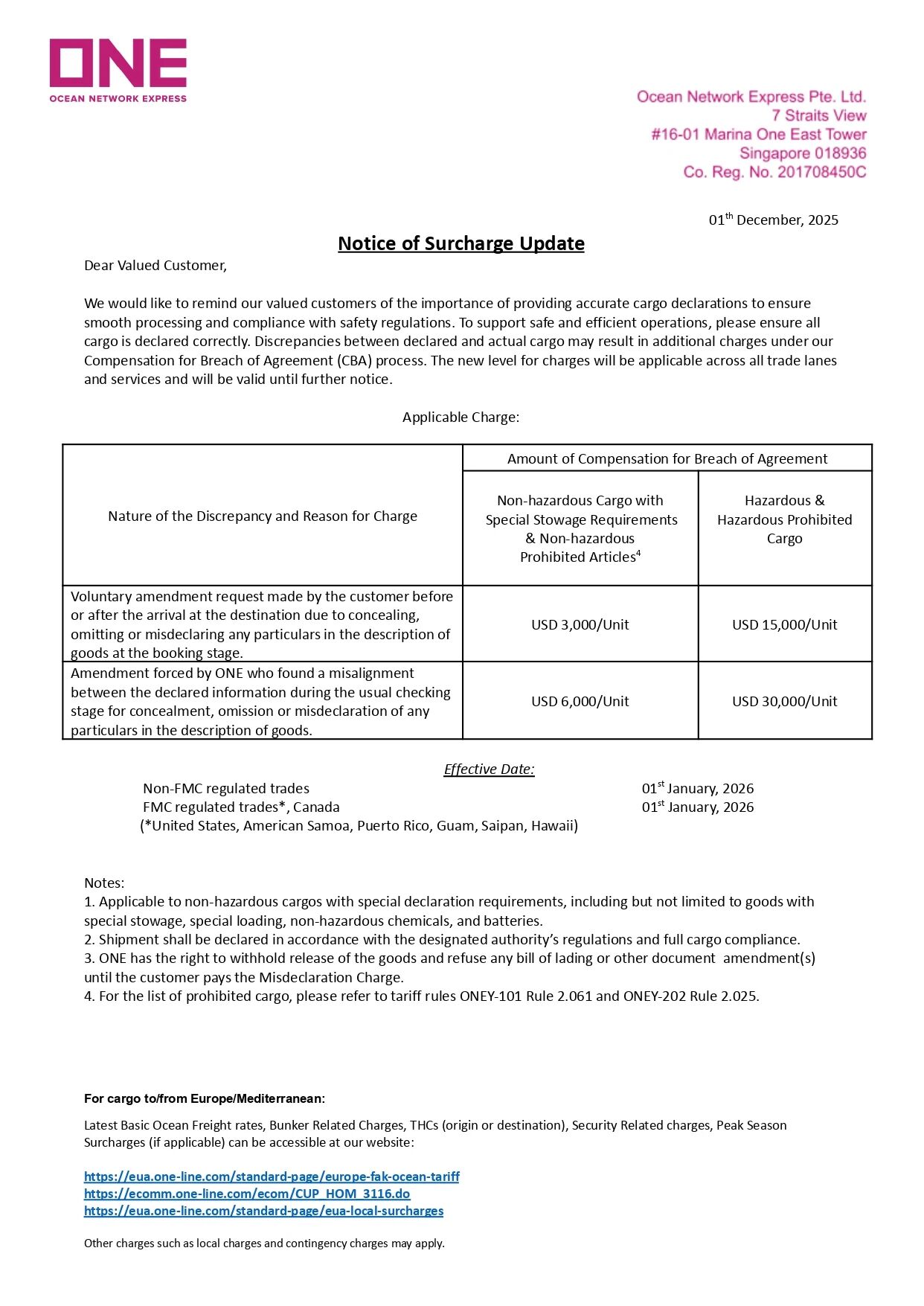
The specific breach-of-contract fee standards are as follows:
1. Non-hazardous goods and non-hazardous prohibited items (with special loading requirements)
Voluntary Modification by Customer: If a customer submits a voluntary declaration for modification before or after the goods arrive at their destination, due to the omission, concealment, or incorrect declaration of any details in the product description during the booking stage, the fee will be USD 3,000 per container.
Mandatory Modification by ONE: If ONE discovers during routine inspections that the declared information does not match the actual information, or if there is any concealment, omission, or inaccurate declaration of details in the product description, and is therefore compelled to carry out a mandatory modification, the fee will be USD 6,000 per carton.
2. Dangerous goods and prohibited dangerous items
Voluntary Modification by Customer: If a customer submits a voluntary amendment to the declaration before or after the goods arrive at the destination, due to the omission, concealment, or inaccurate declaration of any details in the product description during the booking stage, the fee will be USD 15,000 per container.
ONE Mandatory Modification: If ONE discovers during a routine audit that the declared information does not match the actual information—specifically, if there is any concealment, omission, or inaccurate declaration of details in the product description—resulting in a mandatory modification being required, the fee will be USD 30,000 per container.
This is not an isolated case—Maersk has previously imposed fines of US$15,000 per container for misreporting dangerous goods, and Wan Hai Lines even charges a penalty of US$100,000 per container for falsely declared cargo. Behind the shipping companies’ collective “hard-line approach” lies the grim reality: 73% of maritime accidents involving dangerous goods are caused by misreporting or underreporting. The 2024 explosion at Ningbo Port and the damage to containers at Incheon Port in South Korea were both triggered by dangerous goods being disguised as ordinary cargo.
The core of compliance reporting: Uphold three “zero errors.”
01 Zero Deviation in Declaration Information
• Be precise with product names: Write “LED light (110V-240V, 304 stainless steel base)” instead of “lighting fixture” to avoid vague descriptions that could lead to misinterpretations.
• The value of goods is reasonable: It must be consistent with the contract and payment vouchers, and any deviation should not exceed 30% of the market price. Both underreporting and overreporting will trigger customs inquiries.
• Hazardous materials must be clearly indicated: Lithium batteries must be labeled UN3481, and fire extinguishers must be declared as UN1044, accompanied by an MSDS and a test report.
02 Document association with zero contradictions
The consignor and consignee, HS codes, and quantities on the bill of lading, invoice, packing list, and customs declaration must be completely consistent. Baiyun.com recommends using the “Triple Document Verification Method” before shipment: cross-verification among business, operations, and customer service teams.
03 No omissions in the destination country's regulations
The United States requires electronic products to be accompanied by FDA certification; the European Union mandates that batteries must be accompanied by a UN38.3 report; and Saudi Arabia prohibits the entry of alcohol-containing goods.
Import restrictions can be checked via the “Single Window” or third-party databases to avoid returns due to missing documentation.
Practical Guide to Avoiding Pitfalls: Building a Firewall in Three Steps
01 Pre-shipment Verification: For high-risk goods such as chemicals and batteries, entrust a third-party agency to conduct testing and issue a report. Refuse to take the risky approach of simply believing a customer’s claim that something isn’t dangerous.
02 Tool Empowerment: Use AI systems to verify HS codes (such as customs pre-classification services), apply for advance price rulings on high-value goods, and proactively define compliance boundaries.
03 Proactive Remediation: Within 24 hours of discovering an inaccurate declaration, enterprises may initiate the “proactive disclosure” procedure. Chinese customs will exempt from penalties those cases where underpaid taxes amount to no more than 1 million yuan and are promptly corrected.
Hui Jietong’s warm reminder: Compliance is the only path to long-term success.
From $3,000 to $30,000—the range of fines imposed by shipping companies represents precisely the minimum threshold for compliance. In light of the lessons learned from the fire at the Port of Los Angeles, “accurate declaration” is no longer just a bonus—it has become an absolute necessity for survival. Don’t harbor any侥幸 (lucky) attitudes such as “it’s impossible to detect mixed cargo” or “reporting a slightly lower value can help cut costs!”
Whether it’s disguising hazardous materials as ordinary goods, underreporting the value of high-value items, or concealing the true composition of the goods, once such practices are detected during inspection, at the very least the goods will be detained and delivery will be delayed, damaging customer trust. At worst, it could lead to the entire shipment being held up, triggering general average, or even causing safety incidents such as fires or explosions, resulting in irreparable loss of life and property.
Compliance reporting is not a “burden”—rather, it’s a “shield” that safeguards your own rights and interests. Every careful verification of documents and every meticulously prepared qualification document serves to ensure the safe and smooth transport of goods. Upholding the compliance baseline is not only a responsibility toward your own business but also an essential step in ensuring the security of the global maritime supply chain.
END
Shenzhen Huijetong International Freight Forwarding Co., Ltd. – Professional U.S. West Coast Shipping Services
In the U.S.-bound shipping sector, Shenzhen Huijetong International Freight Forwarding Co., Ltd. has become a trusted choice for numerous clients thanks to its professional services and extensive experience. Specializing in U.S.-bound transportation, Huijetong International Freight Forwarding Co., Ltd. offers comprehensive logistics solutions, including sea freight, air freight, land transportation, and warehousing services. The company maintains close cooperation with major shipping alliances, enabling it to provide flexible space arrangements and highly efficient transportation services tailored to customer needs.
Choosing Huijietong International Freight Forwarding Co., Ltd. means choosing professional, efficient, and reliable logistics services. For more details, please visit [Huijietong’s official website www.szvif.com].
If you're heading to the U.S., choose Hui Jietong!
Shenzhen Huijetong International Freight Forwarding Co., Ltd.—your professional partner for U.S. ocean freight services.
Service hotline: 13560787209

WeChat QR code
Logistics Query
Quickly obtain the latest logistics information


Scan code contact
Address: 25/F Room C,Tower A, Honglong Century Plaza, No. 4002 Shennan East Road,Luo Hu District, Shenzhen, China
Zhongshan Address: Room 805, Floor 8 , Poly Plaza office Building, No. 1 Shiji East Road, Port Town, Zhongshan, Guangdong
Changsha Address: 12020, Building 2, Fudi Xingguang Tiandi, Yuhua District, Changsha .,Hunan
Indonesian company:PT VTOP LOGISTIK INTERNATIONAL
Indonesian address:Jalan Pantai Indah Barat Komplek Toho Blok A No 18 ,Kec.Penjaringan,Kel.Kamal Muara,Jakarta Utara

WeChat ID
Scan code contact