


All categories >
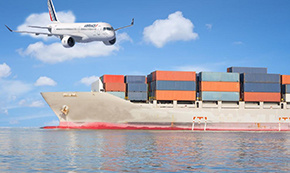
The United States is considering imposing high port fees on Chinese vessels, potentially causing a dramatic shift in the global shipping landscape!
Categories:
Time of issue:
2025-03-07 17:38

In the global trade landscape, the shipping industry has always been the lifeline connecting national economies. However, a recent proposal from the United States Trade Representative (USTR) could stir up a storm in the global shipping industry. This proposal aims to impose high port fees on ships manufactured in China and their related ship owners. Once implemented, it will not only directly affect the shipping pattern between China and the United States but may also trigger a chain reaction in the global supply chain.。
High Port Fees: Who Will Foot the Bill?
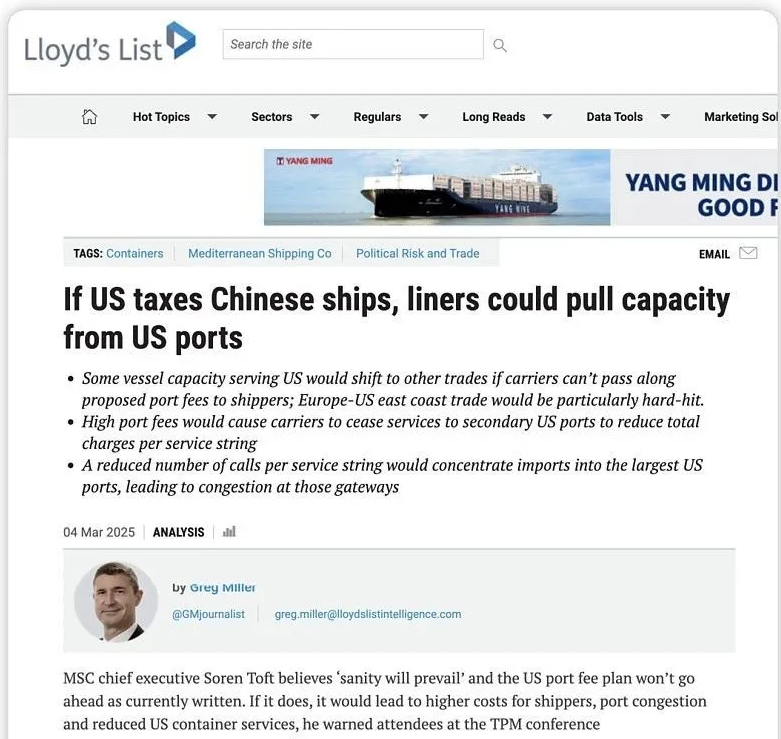
The USTR's proposal attempts to put pressure on Chinese ship owners by imposing high port fees on ships made in China. However, the key question is whether shipping companies can pass this cost on to their customers, especially cargo owners. If shipping companies cannot pass on these fees, the most direct consequence will be that ship operators will have to reduce routes or withdraw some capacity.
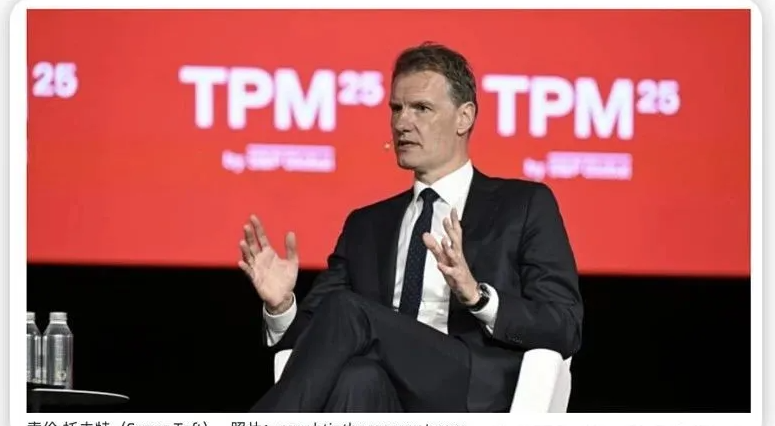
Soren Toft, CEO of MSC and chairman of the Global Shipping Council, raised the "worst-case scenario" of this policy at the TPM meeting in Long Beach, USA - if the proposal is implemented as planned, the global shipping pattern will undergo a dramatic change. He pointed out that, if implemented according to the current plan, especially on the US East Coast routes, the cost per port call could reach up to US$1 million, and each ship usually needs to call at multiple ports, resulting in extremely high final expenses. If these costs cannot be passed on to the cargo owners, shipping companies will face unbearable economic pressure, and may even withdraw from certain routes.
US Ports Under the Effect of Scale: Major Ports Will Face Greater Pressure
As shipping companies cut capacity services, the remaining capacity will be concentrated in a few ports. This will inevitably exacerbate congestion at major ports, especially super-ports like Los Angeles/Long Beach and New York/New Jersey. Soren Toft warned: "If more capacity is concentrated in these major ports, the ports' throughput capacity will be difficult to cope with, leading to serious congestion." He emphasized that the current port system is still fragile, and any external pressure could lead to system instability.
In addition, smaller secondary ports, such as the Port of Oakland in California and some peripheral ports on the East Coast, will face even more severe survival tests. Shipping companies may choose not to call at these ports because the extra cost per call is too high. "If the cost of each call increases to US$1 million, we will naturally abandon those inefficient ports."
US Port Fees and Global Supply Chains: How to Deal with the "Tax Spillover" Effect?
This US proposal is not merely an economic sanction against Chinese ships; its side effects will spread to the global trade pattern. Toft pointed out that port fees will directly affect the increase in US consumer Prices, thus exacerbating inflationary pressure in the United States. "The ultimate consequence of increased port fees may shift the burden to US consumers, resulting in higher commodity Prices, which is essentially equivalent to adding a new tax for US consumers and businesses."
More noteworthy is that the introduction of port fees may encourage some cargo owners to bypass US ports through other channels, instead choosing to transport goods through the ports of neighboring countries such as Canada and Mexico, and then transport them to the United States by land. This phenomenon will not only reduce the throughput of US ports, but may also put greater pressure on US domestic rail and road transport, thereby affecting the competitiveness of US export enterprises.
Can the Shipping Industry Successfully Meet the Challenges?
Against the backdrop of an increasingly complex global economic environment, shipping companies face unprecedented challenges. The US port fee policy, if implemented, will force shipping companies to reconsider their global network layout. In the future, shipping companies will have to adopt more flexible strategies to address changing market demands and policy environments.
Shipping companies need to pay more attention to operational efficiency and cost control. In order to cope with high port fees, reducing calls at inefficient ports and optimizing routes and port selection will be one of the important strategies for the shipping industry in the future. Secondly, shipping companies may rely more on data and technology, improving the intelligence level of capacity allocation and route planning to reduce unnecessary costs. In addition, the future of the shipping industry will not only depend on a single market; changes in the US market and changes in global trade will jointly shape the future ecosystem of the shipping industry.
Overall, the introduction of the US port fee proposal, whether or not it is ultimately implemented, serves as a wake-up call for the global shipping industry. Global shipping companies need to be prepared for policy changes, and both inside and outside the industry should pay more attention to the reshaping of global supply chains and changes in the market landscape that may be caused by policy changes. On this complex global stage, those who can plan ahead will be able to gain an advantage in future competition.
Shenzhen Huijietong International Freight Forwarding Co., Ltd. - Professional US Line Transportation Services
In the US line transportation field, Shenzhen Huijietong International Freight Forwarding Co., Ltd., with its professional services and rich experience, has become the trusted choice of many customers. Huijietong International Freight Forwarding Co., Ltd. focuses on US line transportation, providing a full range of logistics solutions, including sea freight, air freight, land freight, and warehousing services. The company maintains close cooperation with major shipping alliances and can provide flexible space arrangements and efficient transportation services according to customer needs.
Choosing Shenzhen Huijietong International Freight Forwarding Co., Ltd. means choosing professional, efficient, and reliable logistics services. For more details, please visit [Huijietong official website www.szvif.com]
For the US, choose Huijietong!
Shenzhen Huijietong International Freight Forwarding Co., Ltd., your professional US line transportation partner.
Service Hotline: 0755-82171929 13560787209
WeChat QR Code
Follow us to get the latest updates on global shipping and trade!
Logistics Query
Quickly obtain the latest logistics information


Scan code contact
Address: 25/F Room C,Tower A, Honglong Century Plaza, No. 4002 Shennan East Road,Luo Hu District, Shenzhen, China
Zhongshan Address: Room 805, Floor 8 , Poly Plaza office Building, No. 1 Shiji East Road, Port Town, Zhongshan, Guangdong
Changsha Address: 12020, Building 2, Fudi Xingguang Tiandi, Yuhua District, Changsha .,Hunan
Indonesian company:PT VTOP LOGISTIK INTERNATIONAL
Indonesian address:Jalan Pantai Indah Barat Komplek Toho Blok A No 18 ,Kec.Penjaringan,Kel.Kamal Muara,Jakarta Utara

WeChat ID
Scan code contact