


All categories >
Solution

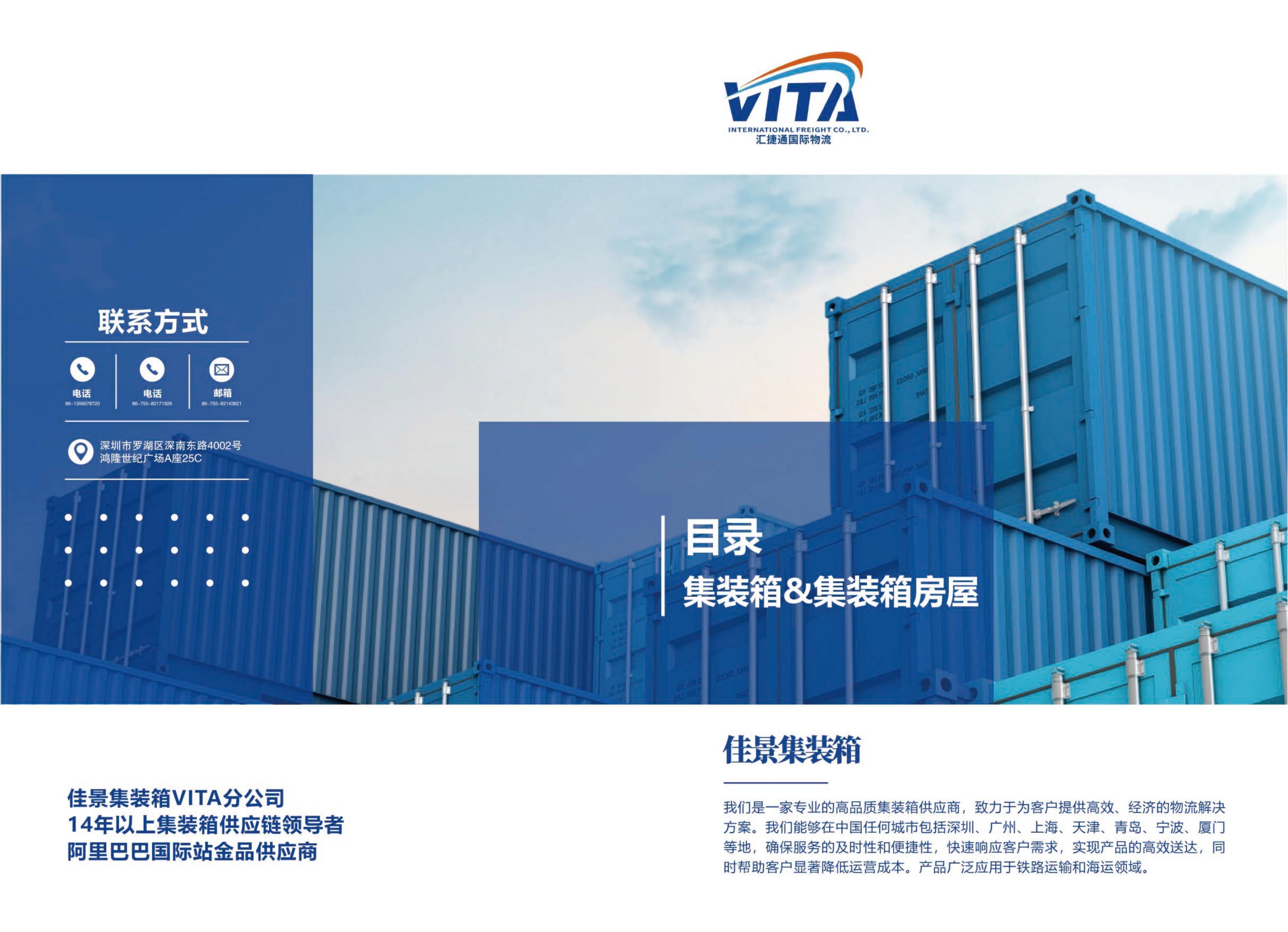
JK Container VITA Branch The company mainly operates in containers & container houses. With over 14 years as a leader in the container supply chain and a Gold Supplier on Alibaba International Station, we are a professional enterprise focused on high-quality container supply. We are committed to providing customers with efficient and reliable logistics solutions to meet the needs of various industries. We can provide customized container services for you in any city in China, ensuring timely and efficient delivery while helping customers save operating costs. The company headquarters is located in Shenzhen, with branches in several major port cities including Guangzhou, Shanghai, Tianjin, Qingdao, Ningbo, and Xiamen. Products are widely used in rail and sea transportation, and have won the trust and praise of numerous customers with their excellent quality and performance. Service Hotline: 0755-82171929 13560787209

> Container shipments held at the port, airfreight rejected by airlines, platform listings delisted—90% of these nightmare scenarios stem from incomplete export documentation. Today, we’ll clarify the four key certificates to help you unlock the “Ren and Du meridians” of international trade logistics.

When engaging in U.S.-bound trade, it’s no longer sufficient to rely solely on standard Most-Favored-Nation (MFN) tariff rates. As a cross-border logistics provider serving more than 3,000 exporting companies, Huijietong found that, among the U.S.-route customs clearance cases handled in 2026, return shipments, penalties, and order losses resulting from tariff misclassification still accounted for 37% of all irregularities.

Shipping containers are one of the most fundamental and essential logistics carriers in modern international trade. They function like “movable standard cargo units”: after being loaded and sealed at the factory, they are transported by truck to the port, then loaded onto ocean-going vessels for delivery worldwide. Along the way, there is no need to unpack or transship the goods, truly enabling seamless door-to-door service.

Detailed Explanation of Two IOR Compliance Paths in the United States: Background and Key Changes Under CBP’s 2026 Policy In 2026, U.S. Customs and Border Protection (CBP) will take strong enforcement action against gray‑area customs clearance practices such as “double‑clearance with tax‑included” services, reliance on fictitious IORs, and shell companies. The core prohibitions include:

Attention, international trade business owners: In 2026, the export tax rebate policy will undergo several significant changes. From filing deadlines and invoice issuance to product rebate rates and foreign‑exchange collection requirements, every step directly impacts your bottom line. Even a single incorrectly issued invoice could result in the failure of an entire refund claim. Huijietong has compiled the key updates—please save this information and share it with your finance team.
Logistics Query
Quickly obtain the latest logistics information


Scan code contact
Address: 25/F Room C,Tower A, Honglong Century Plaza, No. 4002 Shennan East Road,Luo Hu District, Shenzhen, China
Zhongshan Address: Room 805, Floor 8 , Poly Plaza office Building, No. 1 Shiji East Road, Port Town, Zhongshan, Guangdong
Changsha Address: 12020, Building 2, Fudi Xingguang Tiandi, Yuhua District, Changsha .,Hunan
Indonesian company:PT VTOP LOGISTIK INTERNATIONAL
Indonesian address:Jalan Pantai Indah Barat Komplek Toho Blok A No 18 ,Kec.Penjaringan,Kel.Kamal Muara,Jakarta Utara

WeChat ID
Scan code contact