


All categories >
Solution
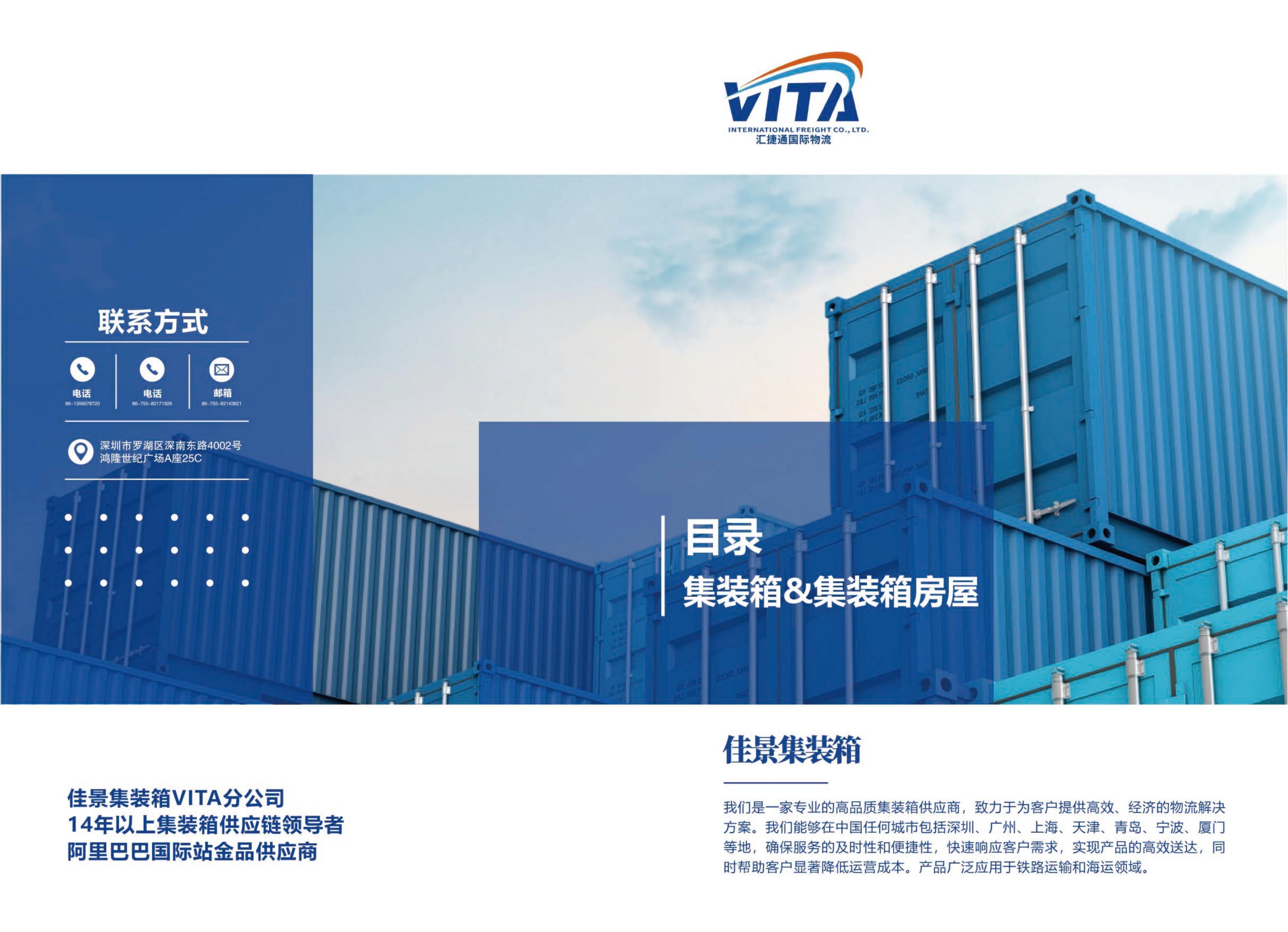
JK Container VITA Branch The company mainly operates in containers & container houses. With over 14 years as a leader in the container supply chain and a Gold Supplier on Alibaba International Station, we are a professional enterprise focused on high-quality container supply. We are committed to providing customers with efficient and reliable logistics solutions to meet the needs of various industries. We can provide customized container services for you in any city in China, ensuring timely and efficient delivery while helping customers save operating costs. The company headquarters is located in Shenzhen, with branches in several major port cities including Guangzhou, Shanghai, Tianjin, Qingdao, Ningbo, and Xiamen. Products are widely used in rail and sea transportation, and have won the trust and praise of numerous customers with their excellent quality and performance. Service Hotline: 0755-82171929 13560787209

For those in international trade and freight forwarding, the most common items they deal with every day—aside from containers and vessel schedules—are the myriad of surcharges. Miss calculating even one on a quote can wipe out your profit; add an unfamiliar charge to the invoice, and you’ll find yourself struggling to explain it to the customer for ages. Today, Huijietong has compiled a comprehensive overview of the most common carrier‑imposed surcharges. We recommend saving this guide so you can quickly reference it when preparing quotes or reconciling invoices next time!

Effective August 1, 2026, five Southeast Asian countries—Vietnam, Thailand, Indonesia, Malaysia, and the Philippines—have jointly implemented new air‑freight regulations for lithium batteries. Less than a month after these rules took effect, many freight forwarders and international traders have already encountered issues such as cargo detention, flight rejections, and customs clearance delays. Today, Huijietong will walk you through exactly what has changed, which types of goods are restricted, how to complete the required declarations, and what packaging standards apply—helping you arrange shipments in full compliance with the new requirements.

Why is the freight for a special container so much higher than that of a standard container?
If you’re involved in exporting large-scale equipment, steel structures, or construction machinery, you’ve probably encountered this dilemma: Even when shipping on the same route with roughly the same transit time, the rates for standard 20GP or 40HQ containers are quite affordable. But as soon as you switch to open-top (OT) or flat-rack (FR) containers, the costs shoot up dramatically. Many people’s first reaction is: “Are freight forwarders just skimming off the top again?” To be honest, that’s not the case. The price difference between specialized containers and standard ones largely stems from higher handling costs, greater labor requirements, and increased risk exposure—far beyond just higher freight charges. Today, Huijietong will break down exactly where these additional costs are going.


Foreign Trade Insights: Risk Comparison of Original Bill of Lading, Telex Release, and Sea Waybill
In international trade, the bill of lading is directly linked to the security of payment; never handle the three types of bills of lading carelessly.
Logistics Query
Quickly obtain the latest logistics information


Scan code contact
Address: 25/F Room C,Tower A, Honglong Century Plaza, No. 4002 Shennan East Road,Luo Hu District, Shenzhen, China
Zhongshan Address: Room 805, Floor 8 , Poly Plaza office Building, No. 1 Shiji East Road, Port Town, Zhongshan, Guangdong
Changsha Address: 12020, Building 2, Fudi Xingguang Tiandi, Yuhua District, Changsha .,Hunan
Indonesian company:PT VTOP LOGISTIK INTERNATIONAL
Indonesian address:Jalan Pantai Indah Barat Komplek Toho Blok A No 18 ,Kec.Penjaringan,Kel.Kamal Muara,Jakarta Utara

WeChat ID
Scan code contact