


All categories >
The new Southeast Asia route at Qingdao Port is launched, strengthening the new momentum of its position as a shipping hub.
Categories:
Time of issue:
2024-12-06 17:58
Overview of new routes
Launch time: December 2024.
Operating vessels: The "CMA CGM Louis" is docked at the Qingdao Port front bay container terminal. This route is jointly launched by CMA CGM and COSCO Shipping, with an expected deployment of 4 operating vessels.
Port of call: Southbound via Singapore Port, directly to Port Klang, the largest port in Malaysia.
Capacity scale: The "CMA CGM Louis" operates 1,350 TEUs at the port.
Service advantages
Improved logistics speed: Provides a faster and more stable weekly service for trade between China and Southeast Asia. The streamlined port of call greatly facilitates the trade route from North China to Southeast Asia, helping to improve cargo transport efficiency and reduce transport time.
Consolidating hub status: Further consolidates Qingdao Port's status as a Northeast Asia international shipping hub, enhancing its role as a "maritime gateway" and a junction point for the "Belt and Road" initiative, which is significant for promoting regional economic development and strengthening international trade cooperation.
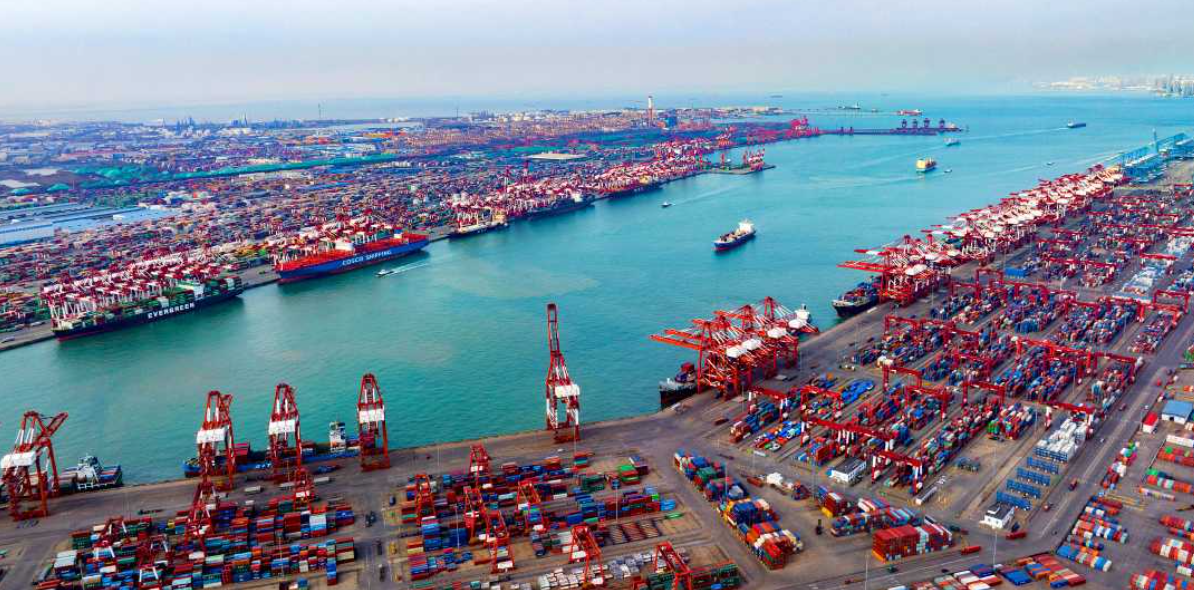
Expansion of Qingdao Port's route network
New routes added this year: Since 2024, Qingdao Port has added a total of 13 "Belt and Road" routes, further weaving a dense port route network to provide high-quality international logistics channels for trade enterprises.
Coverage of routes: Currently, Qingdao Port has opened over 200 container routes, reaching more than 700 ports in over 180 countries and regions worldwide. Its routes cover not only traditional areas such as Asia, Europe, and North America but also actively expand into emerging markets like South America and Africa.
Positive impact on trade
Promoting trade exchanges: Provides a more convenient and efficient transport channel for trade between China and Southeast Asia, helping to reduce trade costs, improve trade efficiency, and further promote trade exchanges between both parties, driving the common development of the regional economy.
Expanding market space: Adds a fast channel for enterprises to export to the Southeast Asian market, helping companies effectively reduce export costs, improve export efficiency, enhance the market competitiveness of regional export products, and allowing enterprises to adjust export strategies more flexibly, expand international market share, and strengthen competitiveness in the Southeast Asian market.
Logistics Query
Quickly obtain the latest logistics information


Scan code contact
Address: 25/F Room C,Tower A, Honglong Century Plaza, No. 4002 Shennan East Road,Luo Hu District, Shenzhen, China
Zhongshan Address: Room 805, Floor 8 , Poly Plaza office Building, No. 1 Shiji East Road, Port Town, Zhongshan, Guangdong
Changsha Address: 12020, Building 2, Fudi Xingguang Tiandi, Yuhua District, Changsha .,Hunan
Indonesian company:PT VTOP LOGISTIK INTERNATIONAL
Indonesian address:Jalan Pantai Indah Barat Komplek Toho Blok A No 18 ,Kec.Penjaringan,Kel.Kamal Muara,Jakarta Utara

WeChat ID
Scan code contact